The quarter
The Neustadt after dark
The Äußere Neustadt around the revue’s theatre: an 18th-century street plan the bombing spared, its bars and courtyards, and what to see before curtain.
Check for a revue night ↗Quick answer
The revue’s theatre stands on Prießnitzstraße in the Äußere Neustadt, the quarter north of the Elbe also called Antonstadt. Its streets were laid out in 1745, its houses largely date from a late 19th-century boom, and it came through the bombing of Dresden with little damage. Today it is known for its bars, painted house fronts and the courtyards of the Kunsthofpassage, which makes it an easy place to spend the hours before the show.
Outside the old walls
The Äußere Neustadt, the outer new town, is the part of the Neustadt that lies outside the line of the old town walls. It is also known as Antonstadt, after King Anton of Saxony. The land was released for building in 1701, and in 1745 it was divided into plots and given most of the streets it still has. Early businesses included a foundry and an alum works, which gave Alaunstraße its name. The quarter’s eastern edge is the little Prießnitz river, the stream that flooded the theatre in 2013.
Spared in 1945
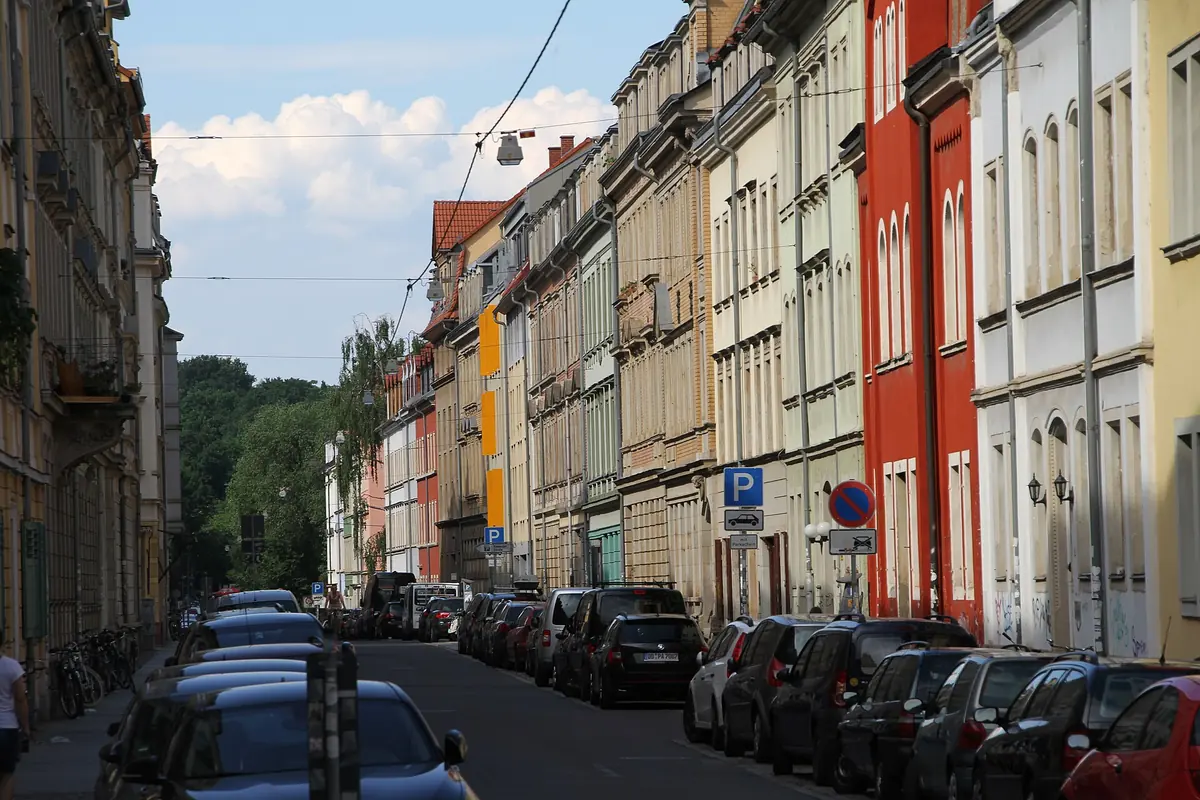
The quarter boomed in the late 19th century, when many of its characteristic houses went up. English Wikipedia calls it one of the largest urban areas in Germany with enclosed Wilhelminian-era architecture, and links that to the fact that the bombing of Dresden in the Second World War largely spared it. That is the contrast worth seeing: across the river, the old town was destroyed and rebuilt, while here whole streets of apartment blocks survive, many now with painted fronts. Prießnitzstraße, the theatre’s street, also has studios, galleries and other venues.
Bars and the after-show crowd
The Äußere Neustadt is thought to have one of the liveliest bar scenes in Germany, with a high concentration of bars, clubs and cafés. For a revue evening that means two easy options: eat and drink in the quarter before the show and order only drinks at your table, or stay at the theatre for the after-show bar and walk out into a district that is still awake. Every June the quarter holds its own street festival, the Bunte Republik Neustadt, which has run each year since 1990 and grown into the largest district festival in eastern Germany.
The Kunsthofpassage
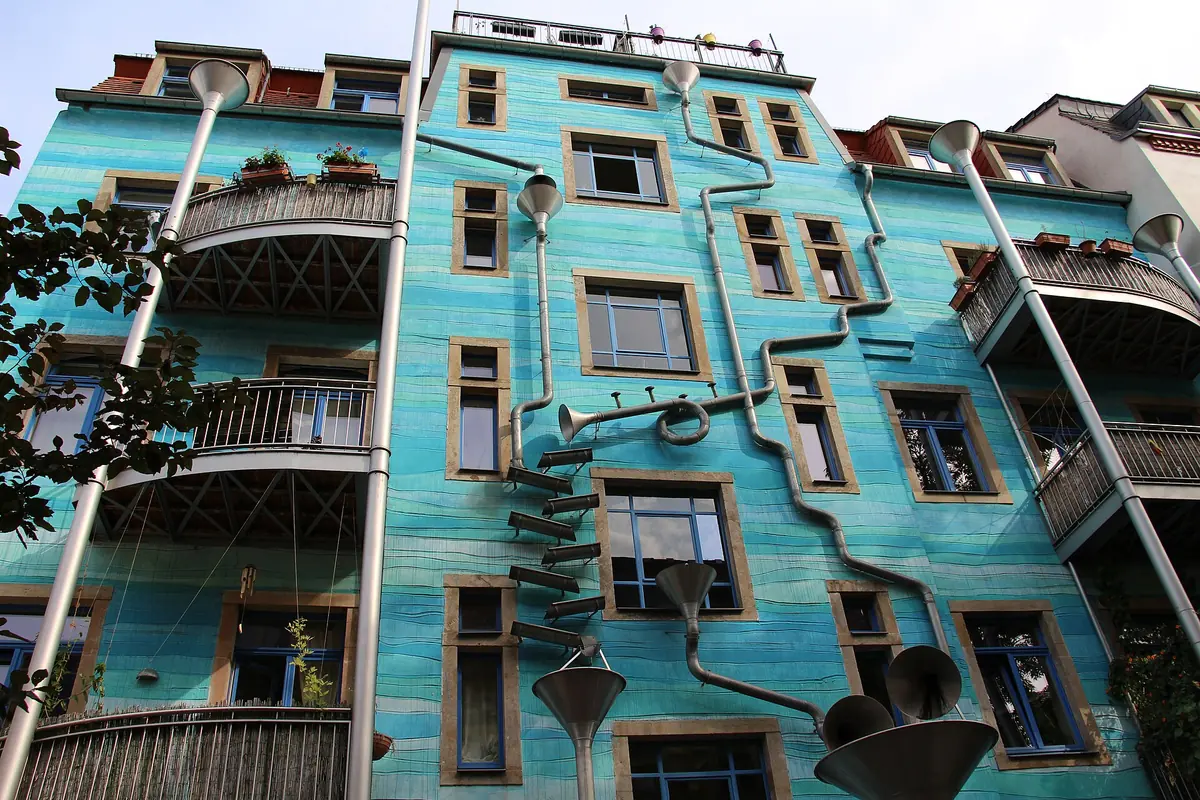
If you arrive early, the one place to see is the Kunsthofpassage, just off Görlitzer Straße: a set of five courtyards whose buildings are decorated with artwork, small shops, galleries and cafés. The best known is the courtyard with a façade of funnels and pipes that plays musical notes when it rains. It lies in the same quarter as the theatre and makes a good half hour before dinner, especially in daylight, when the colours show at their best.
Chocolate, milk and a church
Three more stops for the curious. Pfunds Molkerei, a dairy shop decorated with neo-Renaissance tiles by Villeroy & Boch, is known as the world’s most beautiful dairy. English Wikipedia credits the quarter with the world’s first milk chocolate, made in 1839 in a factory between today’s Timaeusstraße and Jordanstraße. And the Martin Luther Church on Martin-Luther-Platz, built from 1883 to 1887, has an 81-metre tower that serves as a landmark across the rooftops. None of these needs more than a few minutes.
Connections
Albertplatz, on the quarter’s southern edge, is the most important tram hub in Dresden north of the Elbe, and Dresden-Neustadt station, the city’s second-largest, is not far away and is served by ICE trains. For the theatre itself, the nearest stop is Diakonissenkrankenhaus, a short walk away, as the next guide explains. Coming from the old town, you cross the Elbe, which makes the trip part of the evening: the lights of the old town are on the far bank on the way back.
Sources