Compare
Revue or night watchman?
Dresden’s travesty revue or the lantern-lit night-watchman walk: two German-language evenings compared on length, setting, ages, food, weather and booking.
Check for a revue night ↗Quick answer
Choose the revue if you want spectacle and a seat for the evening: about two hours of costume, parody and music at tables in a Neustadt theatre, for ages 14 and up. Choose the night-watchman walk if you want the old town itself: an hour and a half on foot behind a costumed watchman with lantern and horn, from Theaterplatz towards the Frauenkirche, with stories told in German. Both are German-language evenings; the revue’s costumes and music carry further without the language.
The two evenings side by side
| Revue | Lantern walk | |
|---|---|---|
| Length | About 2 hours | About 1.5 hours |
| Setting | Theatre, at tables | Old town streets |
| Spoken language | German | German |
| Ages | 14 and over | Not under 10 |
| Wheelchairs | Ramp, lower level | Not suitable |
| Included | Show, after-show party | Walk, small liqueur |
| Free cancellation | 2 days before | 24 hours before |
The short answer
These two Dresden evenings barely overlap. The revue is a seated show in a theatre north of the river: glamour, costume, star parody and adult comedy, with food and drink at your table and a bar afterwards. The night-watchman walk is a guided stroll through the rebuilt old town at the blue hour, led by a costumed watchman who tells spooky stories and anecdotes from many centuries. If you have one evening and little German, the revue gives you more to enjoy without words. If you want to see the old town lit up and hear its stories from someone in costume, take the walk; with two free evenings, do both.
Two sides of the river
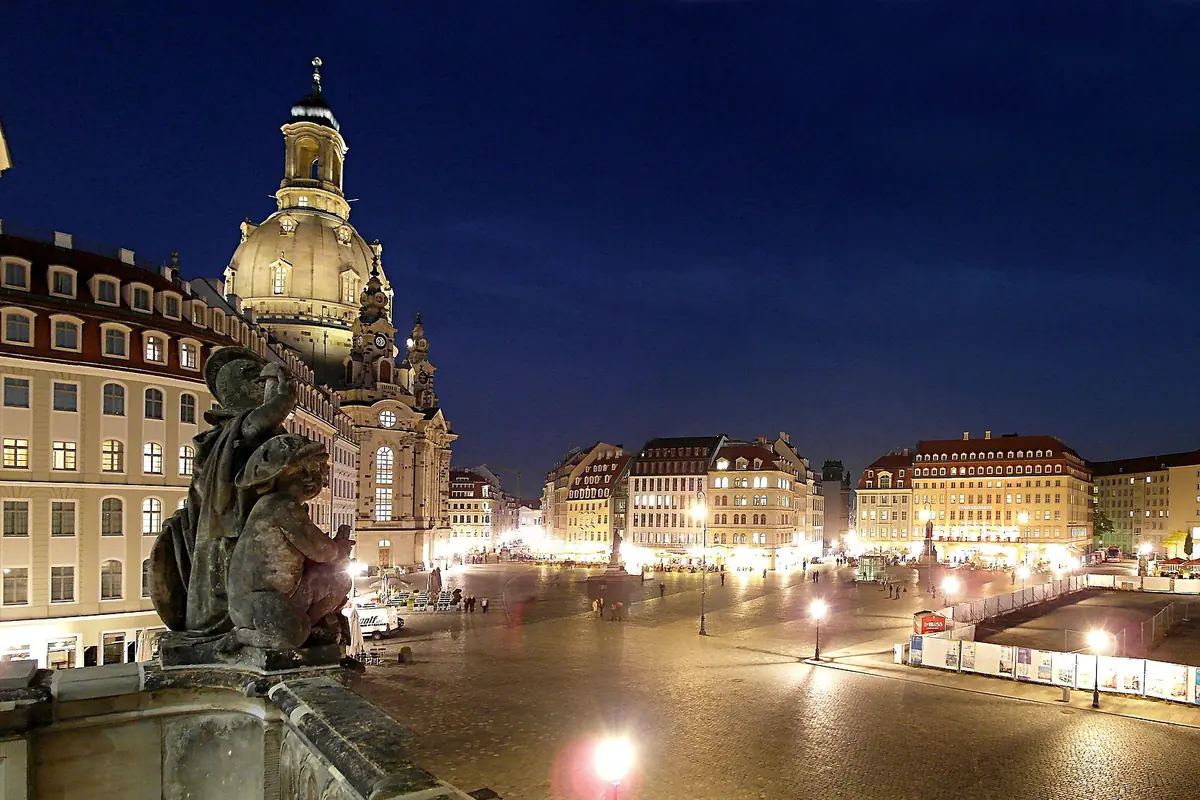
The two evenings take you to different Dresdens. The revue plays in the Äußere Neustadt, the quarter north of the Elbe laid out in the 18th century, which the wartime bombing largely spared and which is now known for its bars. The walk stays south of the river, in the old town whose centre was destroyed in 1945 and partly reconstructed. It starts at the King John monument on Theaterplatz and, on the route the operator shows, passes the Semperoper, the Zwinger, the castle, the Procession of Princes and Brühl’s Terrace before finishing by the Frauenkirche. Routes vary between evenings, but the setting is the point: the walk is about the floodlit Baroque centre, the revue about one room in the Neustadt.
What the walk is
It is a ninety-minute walking tour led by a guide in night watchman’s costume, with a lantern, a horn and a halberd. The tour is pitched at dusk and the blue hour, and its material is stories rather than dates: spooky tales and juicy anecdotes about the city’s past, told as the watchman would have known them. Groups are capped at 25 people, and a small liqueur is served at the start. The stops lie within the compact old town, so the pace is set by the storytelling rather than the walking. It is a gentle, social evening rather than a sightseeing march, and it leaves you in the middle of the old town for dinner afterwards.
Who the night watchmen were
The job is real history. German Wikipedia describes the night watchman as a profession that arose with the first larger towns of the Middle Ages: he walked the streets after dark to keep order, warned sleeping citizens of fire, enemies and thieves, checked that doors and gates were locked, and often called out the hours, sometimes in song. His usual kit was a halberd or similar pole weapon, a lantern and a horn. The work was often counted among the dishonourable trades and poorly paid. Street lighting and new police laws around the turn of the 20th century ended most of these posts; today the role survives in guided tours.
Language: both evenings are German
Here the two are closer than they look. The revue’s compère and comedy are in German, and the walk’s ticket lists German as the guide’s only language. The difference lies in what is left without it. A revue still offers costume, music, dance and parody that anyone can follow, so a visitor with no German gets a full evening of spectacle even if half the jokes pass by. A storytelling walk is almost all words; without German you are left with the lantern, the costume and the floodlit buildings. For anyone with good German, both work equally well, and the choice comes down to mood: an evening of glamour at a table, or an hour and a half of stories in the open air.
Ages, access and group size
The revue ticket has a minimum age of 14, and its humour is aimed at adults. The walk is the family option: children under 10 cannot join it, and up to four child tickets can be booked per adult. Access runs the other way. The theatre has a ramp to the lower audience level and an accessible toilet, and asks to be told in advance about a wheelchair place. Wheelchair users are not catered for on the walk. Group sizes differ too: the walk takes up to 25 people, while the revue fills a theatre, which suits anyone who would rather watch than be part of a small circle.
Weather and comfort
The revue is indoors and seated from start to finish, with a cloakroom by the door, so the weather only matters on the way there. The walk is outdoors for its whole length, standing at each stop while the watchman talks, so dress for the evening air, wear comfortable shoes and bring something waterproof if rain is forecast. For a cold or wet evening the revue is the easier choice; for a mild one the walk shows the old town at its most atmospheric, when the lights come on along the river.
Food and drink
Food is where the revue makes a whole evening of itself. The theatre serves à la carte dishes and set menus at the tables before the show, and drinks throughout, all paid for separately; the after-show bar keeps going once the curtain falls. The walk includes one small liqueur at the start and nothing else, so plan a meal before or after it in the old town. If you want to eat and watch without changing venue, the revue is the answer. If you would rather choose your own restaurant, the walk leaves your evening open, and the old town has plenty of places close to where it finishes.
Booking and cancelling
Dates for the revue appear on the booking page only now and then, so the revue is the evening to secure first; book it when you see a date, then fit the walk around it. Cancellation terms differ. Booked through GetYourGuide, the revue cancels free up to two days before, and the walk up to 24 hours before, both with a full refund. The walk can also be reserved now and paid later, which the revue ticket does not offer. The revue’s voucher needs no printing: show it on your phone at the theatre’s ticket desk.
Who should pick which
Most choices sort themselves out on two questions: how much German your group has, and who is in it. Families with children between 10 and 13 have only one option, the walk, and groups with a wheelchair user have only the revue. Couples and friends without German will get more from the revue. Anyone arriving in Dresden for the first time may enjoy the walk as an introduction, because it covers the old town’s landmarks and their stories in one easy stroll.
- Little or no German, one evening: the revue.
- Children aged 10 to 13 in the group: the walk.
- A wheelchair user in the group: the revue.
- First night in Dresden, getting your bearings: the walk.
- Dinner and a show in one place: the revue.
Doing both
Two free evenings settle the question. The pairing works well: the walk on your first night, to learn the old town and its stories, and the revue on another, for spectacle and a late drink in the Neustadt. Daytime fits around both, with the Zwinger’s galleries or a cruise on the Elbe, as the last guide on this site explains. If only one revue date appears during your stay, book that first and slot the walk into another evening.
Read next: Your days around the revue
Frequently asked questions
Is the night-watchman walk in English?
No. The ticket lists German as the guide’s only language, and the walk is built on storytelling, so it suits German speakers best.
Which is better without German?
The revue. Its costumes, music and star parodies can be followed without the language; the walk relies almost entirely on what the guide says.
Which works for children?
The walk, from age 10. The revue ticket is not suitable for children under 14.
Can I do both on one evening?
Plan them for separate nights. Book the revue first, because its dates are the scarce ones, then choose a walk on another evening.
Which has the easier cancellation terms?
The walk: free up to 24 hours before. The revue cancels free up to two days before. Both refund in full within those windows when booked through GetYourGuide.
Sources
- German Wikipedia, article on Nachtwächter (consulted November 2026)
- The theatre’s visitor FAQ: tickets, seating, food, travel and access (consulted November 2026)
- The theatre’s accessibility page (consulted November 2026)
- English Wikipedia, article on the Frauenkirche, Dresden (consulted November 2026)
- English Wikipedia, article on Äußere Neustadt (consulted November 2026)
- English Wikipedia, article on Dresden (consulted November 2026)